

👋 Hey, it’s Wes. Welcome to my newsletter on managing up, leading teams, and standing out as a high performer. To level up faster, join my course on Executive Communication & Influence. → UPDATE: The September cohort starts in two weeks and is 85% full. Reserve your seat
Read time: 4 minutes
I originally published a version of this essay in May 2020. With the rise of AI, the post is even more relevant today.
Employees used to swim in their own lane. That doesn’t work anymore.
At all types of organizations, I’m seeing more high-performers get rewarded when they can handle projects end-to-end. If a normal operator is an infantry soldier, these operators are Navy SEALs. They can parachute into unknown territory to quickly assess a situation. Then determine the best course of action.
They are strategic, flexible, disciplined, and tight in their execution.
End-to-end marketers have vision, can develop a strategy, and can execute to bring their idea to life.
Another way to think about this type of person: they have all the skills, resourcefulness, and savvy to be an entrepreneur. But they often prefer to work within organizations as intrapreneurs.
Let’s say a marketer wants to create a video series for their company. Imagine these two scenarios:
Marketer #1:
Has the idea, but doesn’t know what to do next. Expects their boss or subject matter experts to fill in the details.
Marketer #2:
Drafts the script copy themselves
Films a quick video on their iPhone themselves
Edits in iMovie themselves
Creates a mock LinkedIn account to post the video themselves
Shows the leadership team what it would look like
In our new world, marketer #2 will win. Because they’re able to bring their vision to life, they’re more likely to get a green light to move forward.
***
End-to-end operators don’t worry about who’s responsible for the “strategy”, “planning”, and “execution”. They just get the job done.
End-to-end operators take a little and turn it into a lot. What others see as weak signals, an end-to-end operator sees as clues to validate or invalidate their hypotheses. All with the goal of getting closer to the truth of what customers want and how to better serve them.
How do you become an end-to-end operator?
Learn to translate your vision into reality. End-to-end operators aren’t reliant on someone else to tell them what’s feasible. They know enough to say, “Here’s the part we’ve got under control. Here’s the hard part. I might not be able to build it all myself, but I know enough to write a spec.”
Practice switching between strategy and execution. Zoom out at the high-level 10,000-foot view to drive the strategy. Then zoom in 5 feet above ground to personally execute on those recommendations. Repeat.
Act like an owner. Do what it takes to get the job done. Work back channels and understand incentives. Proceed with discretion for delicate matters. Learn how to manage tension.
Turn chaos into order. When things get messy, be the person who sees a way through. Help the rest of the team feel safe. Get the job done without drama or fuss.
Think ahead. Think rigorously. Surface trade-offs so your team won’t be surprised. Don’t assume constraints are as fixed (or flexible) as they might seem at first glance. When everyone else is looking at what’s right in front of them, think ahead about second and third order consequences.
Make assertions—even if you’re working with imperfect information. Where can you raise the bar on what you’re doing and what’s next? What are weak signals worth exploring? It’s your mission to recognize opportunities and then fill in the blanks.
Assume you’re a team of one. This applies especially to the first marketing hire on a lean team. You might tap into designers and developers on the team, but you might not have your own dedicated team yet. You’ll be expected to identify what you need, why you need it, and to find the most collaborative way to get it done. This includes utilizing internal and external resources to help bring your vision to life.
Learn how to learn. You don’t have to be a channel specialist, but you can quickly learn enough about a subject to make smart decisions and execute. You’re comfortable reviewing data and turning it into actionable recommendations. At the same time, you’re deeply empathetic and view empathy as directly related to business success.
Cross train and develop skills in adjacent areas. MMA fighters don’t only know boxing. They know Muay Thai, Brazilian Jiu Jitsu, Taekwondo, Krav Maga, and more. This helps you attack a problem from different angles to find the best solution.
***
You likely have some elements of being an end-to-end operator already. Fill in the gaps that will let you operate even more independently.
When you can bring ideas to life with little outside help, you’ll become the most valuable operator in your company.
Thanks for being here, and I’ll see you in two weeks on Wednesday at 8am ET.
Wes
PS If you enjoyed this post, here are ways to go deeper:
To get my next blog post, join my email list (it’s free)
Learn more about 1:1 executive coaching
Improve your ability to sell your ideas, gain buy-in, and increase your impact in my 2-day workshop. Over 2,300 tech operators from Netflix, Stripe, Meta, Figma, Anthropic, etc have taken the course. → Save your spot
✨ Course update: September cohort is 85% full
A few updates:
The September cohort starts in two weeks and is 85% full. If you’re interested in joining, sign up in the next few days.
The November cohort is the last cohort of the year. After this, the next cohort will likely be in summer 2027.
If you are a leader who wants to send your team, I offer $100 off for groups of 5+ people. Teams from Shopify, Meta, Atlassian, Canva, etc have taken the course together, and are benefitting from having shared shared language. Hit reply and I’ll send more info.
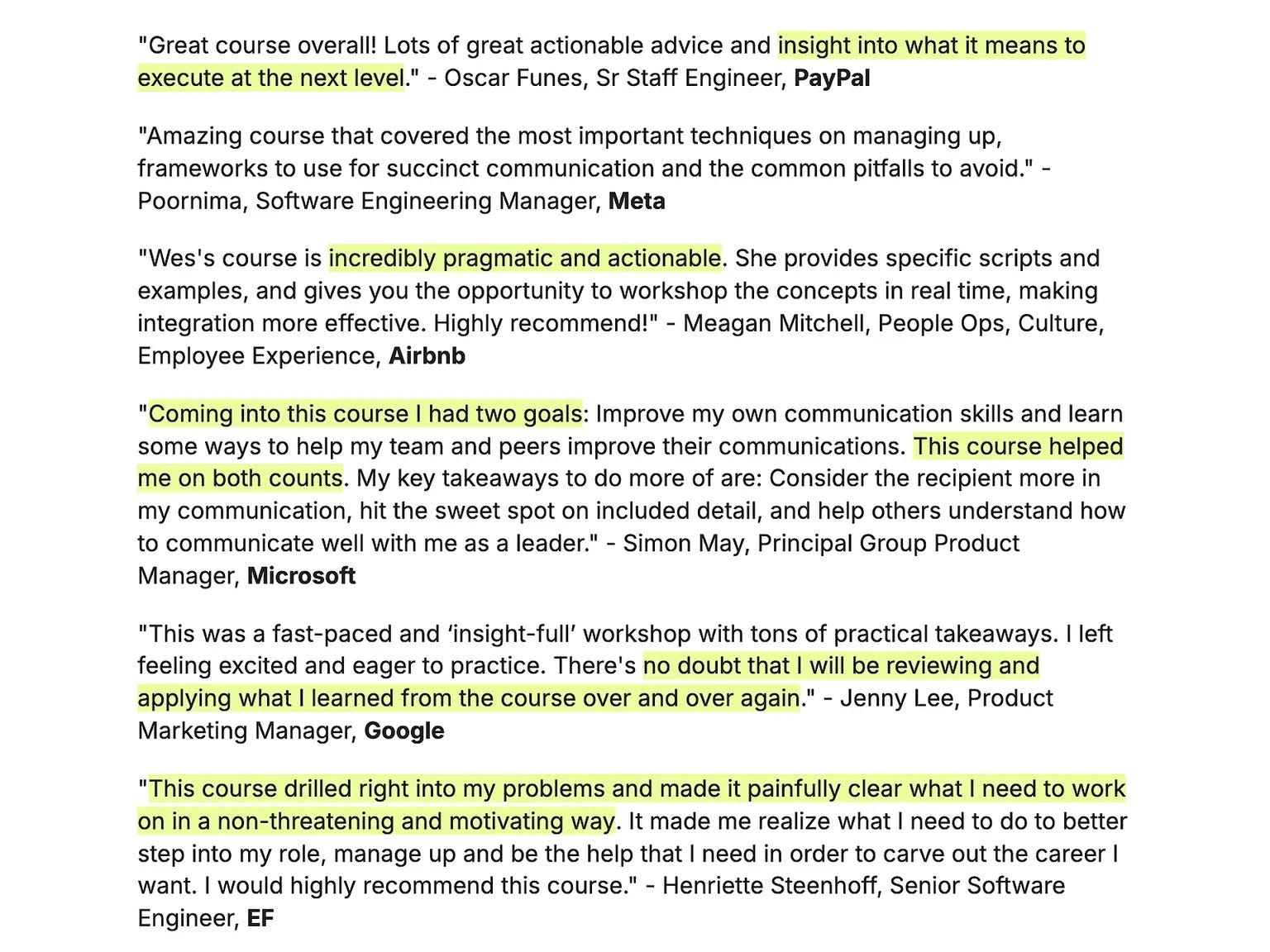
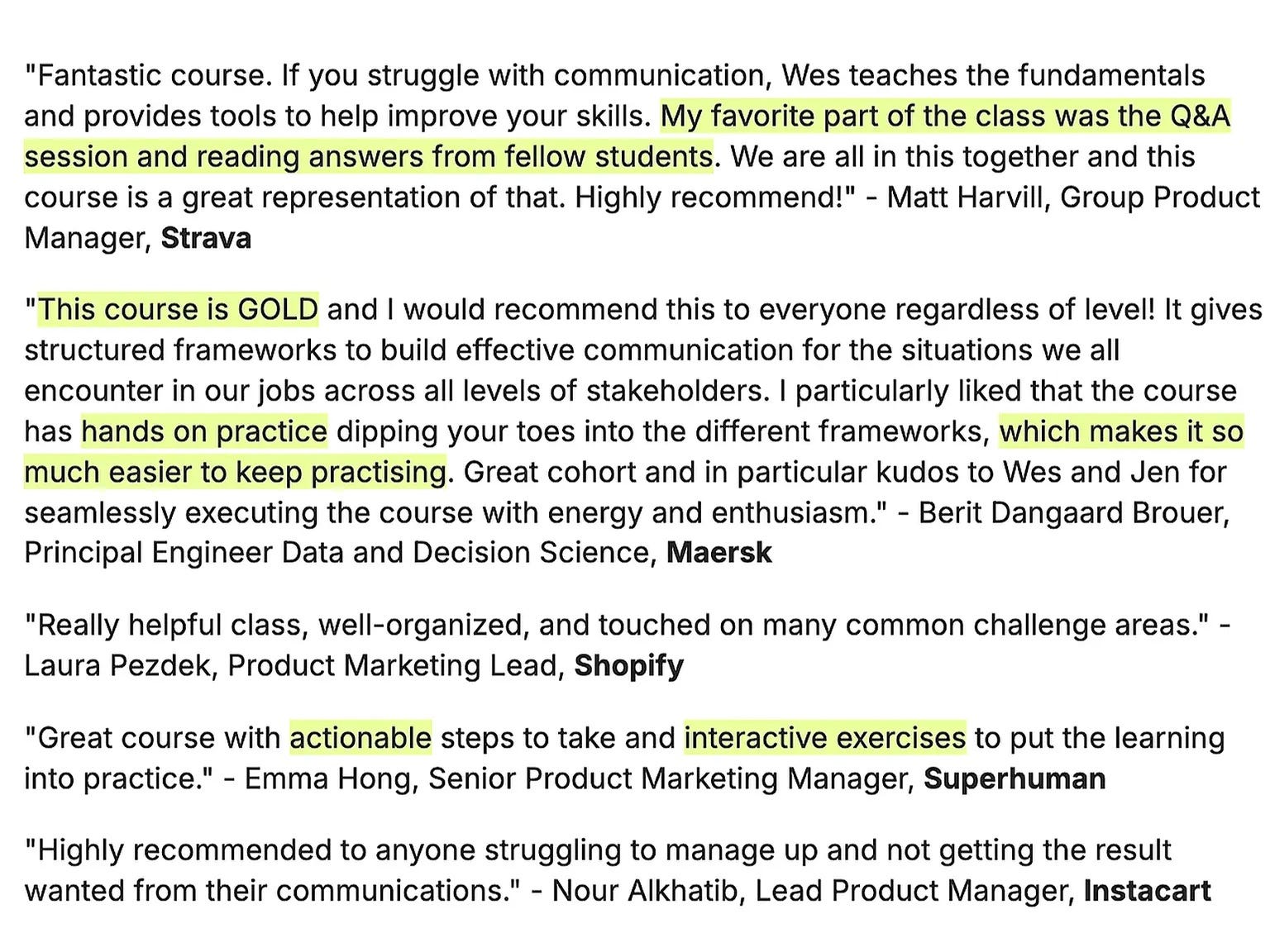
To date, over 2,300 tech operators have taken this course with 942 reviews and 4.6 stars. Here’s what fellow operators are saying:
Are you wondering if the course is right fit for you? Check out course details
I think there’s a Marketer #3 who does all of this but with AI. Builds the strategy, builds ads in Claude/Canva and builds the agent that runs them on Meta.
That person is becoming even more valuable today than Marketer #2.
So good! You were ahead of the curve (as usual), Wes! Thanks for resharing this!