

👋 Hey, it’s Wes. Welcome to my bi-weekly newsletter on managing up, leading teams, and standing out as a high performer. For more, check out my intensive course on Executive Communication & Influence for Senior ICs and Managers. Over 1,500 operators from Netflix, Anthropic, OpenAI, Figma, etc have taken the course.
✨ UPDATE: The March cohort is sold out, but the new May 2026 cohort is now open. → Save your spot
Read time: 4 minutes
Fundamentals is a new series that highlights my core concepts in communication that I personally keep coming back to.
This week’s fundamental principle:

Updated thoughts
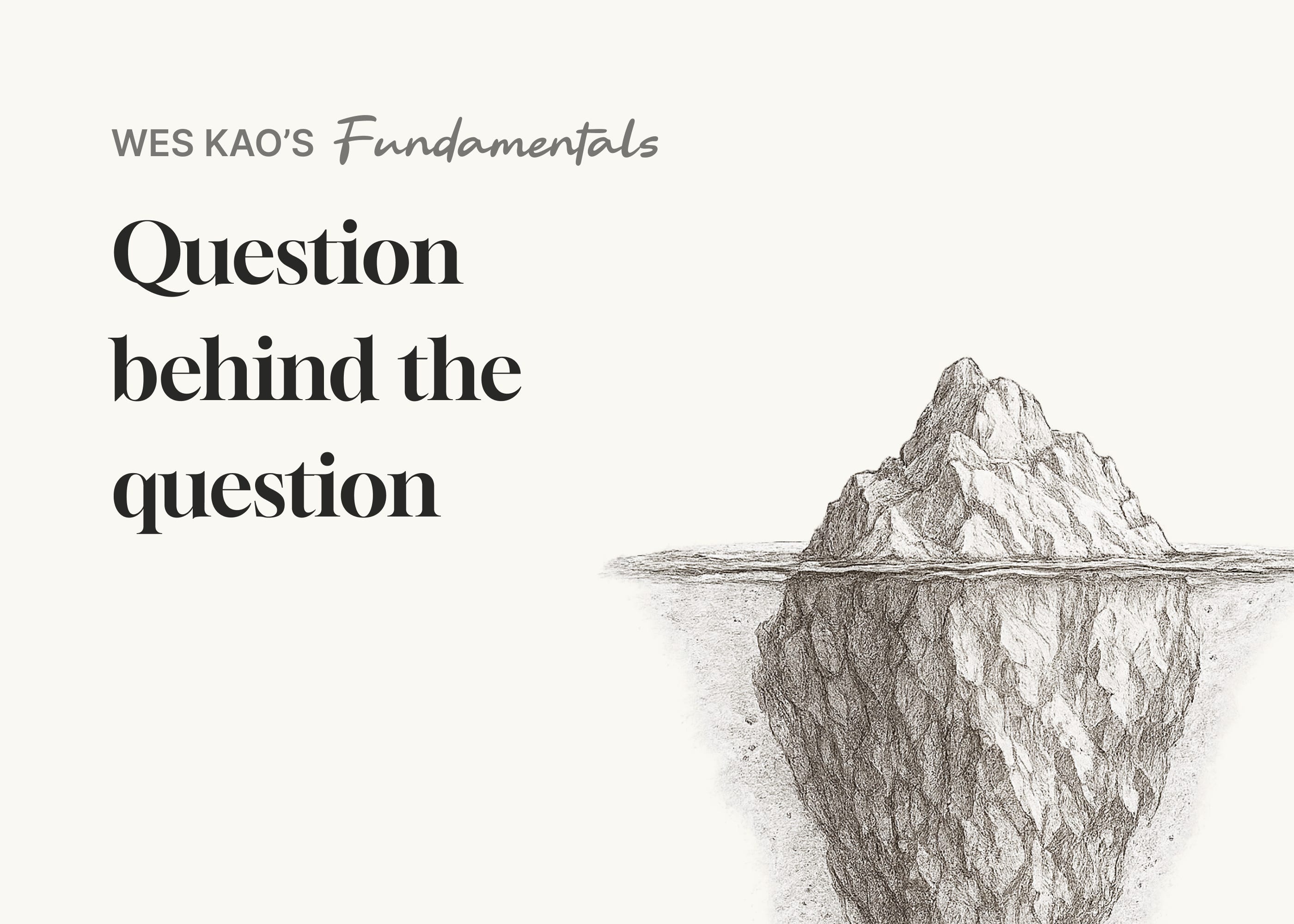
Before you launch into an answer that is overly tactical or too in the weeds, consider the QBQ. This will help you answer at the right altitude. (Practicing how to answer at the right altitude is a concept I teach in my live course.)
Thinking about the question-behind-the-question might feel like an extra step, but once it becomes part of your muscle memory, it only takes a few extra seconds. It becomes second nature. Many times, I don’t even actively think about the QBQ because my brain naturally goes there.
Some readers ask, “Can we just straight up ask ‘what’s the question behind the question?’” Personally, I don’t like doing this because it can sound a bit aggressive. I don’t want to risk insinuating that my recipient is being coy. Instead, I like probing to get a bit more context, or even better: asserting my interpretation and asking them to correct me if I’m wrong. Most people are very happy to tell you if you’re wrong.
If a journalist asks me a question, their underlying QBQ might be: “What is newsworthy and quotable here?” So I try to answer questions in punchy sound-bites that highlight what’s new/interesting. This gives the journalist what they want and is win-win.
If a senior exec asks you a question, the underlying QBQ might be, “How does this impact the business?” Execs are further removed from your work, and they usually care about driving revenue or saving on costs. Avoid diving straight into logistics.
If a prospect/customer asks you a question, they might not be able to articulate what’s really gnawing at them. I’ve noticed the best salespeople answer my tactical surface question AND go deeper to get at the root of the issue.
Here are a few reader comments I want to highlight:
“Earlier in my career, my instinct was to answer as fast as possible to show I was on top of it. Taking a moment to consider the question behind the question was something I had to learn and practice. Not an easy skill but important to learn.
I have found that taking a quick pause before answering gives me a chance to gather my thoughts and decide what approach to take.” - Josh
“I’m familiar with the QBQ and I’ve [been] practicing a lot… especially this part: ‘Your question-asker might not know why they feel skeptical, so you're trying to hit a moving target,’ made me realize that I too often take for granted that people know and have clear what they want to ask.
Which is rarely the case. This will definitely help me not get stuck in never-ending back-and-forth as I often do, moved by my goodwill.” - Concetta Cucchiarelli

Do this today
After you read the article, reflect on these prompts:
Think about a recent situation where you felt like you kept repeating yourself or getting random follow-up questions. What signs did you notice that suggested there was a deeper question you weren’t addressing?
Consider the colleagues you interact with regularly. What are their typical underlying concerns or priorities? How can you proactively address these issues?
Watch out for the next time someone asks you a question you don’t feel like you have enough context to answer. Use this script to uncover their true concern:“Great question. If you could share a bit of context on what's top of mind for you, it’ll help me get a sense of what’s most relevant to share.”
Thanks for being here, and I’ll see you in two weeks on Wednesday at 8am ET.
Wes
Connect with Wes
Is this your first time here? Subscribe (it’s free)
Follow me on LinkedIn for more insights
Learn more about 1:1 coaching to sharpen your executive presence
✨ Course: The March cohort has sold out. The new May 2026 cohort is now open. Improve your ability to sell your ideas, manage up, gain buy-in, and increase your impact in a 2-day workshop. Over 1,500 tech operators have taken this course. → Save your spot
This is a masterclass in 'Managing Up.' In my experience as a senior engineering manager, when a board asks, 'Why is this refactor taking so long?', I feel this post is about predictability.
They are actually asking, can I trust your roadmap enough to make promises to our investors?
If we answer the surface question with technical jargon, we lose their trust. If we answer the QBQ, we gain a partner.
Great article.
the refactor example really got me.. i've watched smart people answer the literal question with technical precision and still lose the room, because the actual question was about trust, not timeline. curious if you have a quick way to tell, in the moment, whether you're being asked the surface question or the real one, since misreading it seems to be the expensive mistake