


👋 Hey, it’s Wes. Welcome to my bi-weekly newsletter on managing up, leading teams, and standing out as a high performer. For more, check out my 2-day course on Executive Communication & Influence → The May cohort is now open
⛑️ If you’re looking to dramatically improve your communication and leadership, learn more about my coaching approach.
I originally published a version of this essay in September 2018, and have since expanded on the topic. Enjoy.
Read time: 5 minutes
I give a talk called “Storytelling for Technical Leaders,” where I share how technical founders and operators can tell better stories and be more compelling to their audiences.
About 1/3 of my private coaching clients are technical (eng managers, staff engineers, startup CTOs, VPs of data science, etc).
From working with dozens of technical leaders, here are the most common storytelling mistakes I see:
1. Over-reliance on technical details
Real-life is non-linear, but stories are linear. Therefore, stories are always a simplification.
Read that again. Stories are always a simplification. In order to simplify, you as the presenter will need to decide which details to include and exclude.
Many technical folks are afraid their audience will call them out for not being comprehensive enough. The paranoia is real and I’ve felt it myself. But the solution is not to be extremely comprehensive all the time, and to treat all details as weighted equally.
Your audience doesn’t want a story weighed down by caveats and technicalities in every other sentence. Your audience wants to be wooed, entertained, and taken on a journey — in addition to learning about your project and vision. If you lose your audience because they’re asleep, they won’t appreciate all the context and details you’re sharing anyway.
What about fellow technical folks or subject matter experts who have questions about specific details? They’ll ask. And you’ll be ready to answer and impress them with your depth.
Anytime you feel the urge to say, “Well, technically…,” you’re about to kill a good story.
Remember: What gets someone in the door isn’t necessarily what gets them to stay.
For example, think about J.Crew. The front of the store has tables with a rainbow assortment of t-shirts in fun patterns and neon yellow.
Nine times out of ten, I walk in…and buy a neutral color (white, black, navy, grey). Most customers do this , which is why retailers plan the inventory accordingly and have stockrooms full of basic SKUs.
But if they put only the most basic stuff on display, you would keep walking and never enter the store.
Hook your audience so you get them in the door. If your audience is eager to hear more, you’ll earn the opportunity to share details.
Ask yourself:
Can I simplify my story to make it even more powerful?
Can I remove tangential comments, so I can focus on my main point?
Am I spending precious time describing context of secondary importance that I could share later?
More on the importance of sales, then logistics.
2. Trying to remember too many tactics
When you are in the moment, don’t try to remember a list of storytelling tips and strategies. This is more likely to make you anxious and worsen your performance.
By all means, practice your pitch. But once you’re out in the wild (in front of a room of colleagues, prospective customers, or at a networking event), let go of the laundry list of things you learned in preparation for telling your story. Don’t feel pressure to stick with word-for-word scripts.
Instead, stay present and focus on eliciting emotion: “How can I make this person’s eyes light up?”
I call it “ELU” for short.

ELU is the moment when your audience gets emotionally invested. We all know when people are listening to us to be polite. And you can tell when someone suddenly wakes up during the conversation and wants to hear more.
It’s hard to anticipate what will resonate with your audiences, so experiment with what you say and look for that spark.
Ask yourself:
How can I stay present, enjoy telling this story, and look for moments when my audience leans in with excitement?
More on Eyes Light Up.
3. Too much backstory
If you’re telling a story about your camping trip, don’t start when you were brainstorming options for tents and carpooling. Start right before you almost get eaten by a bear on a 13 mile hike.
I constantly remind myself to cut backstory, and am usually glad for it. Backstory can easily take up the majority of the time you have during an introductory call or meeting, so be mindful to avoid backstory scope creep.
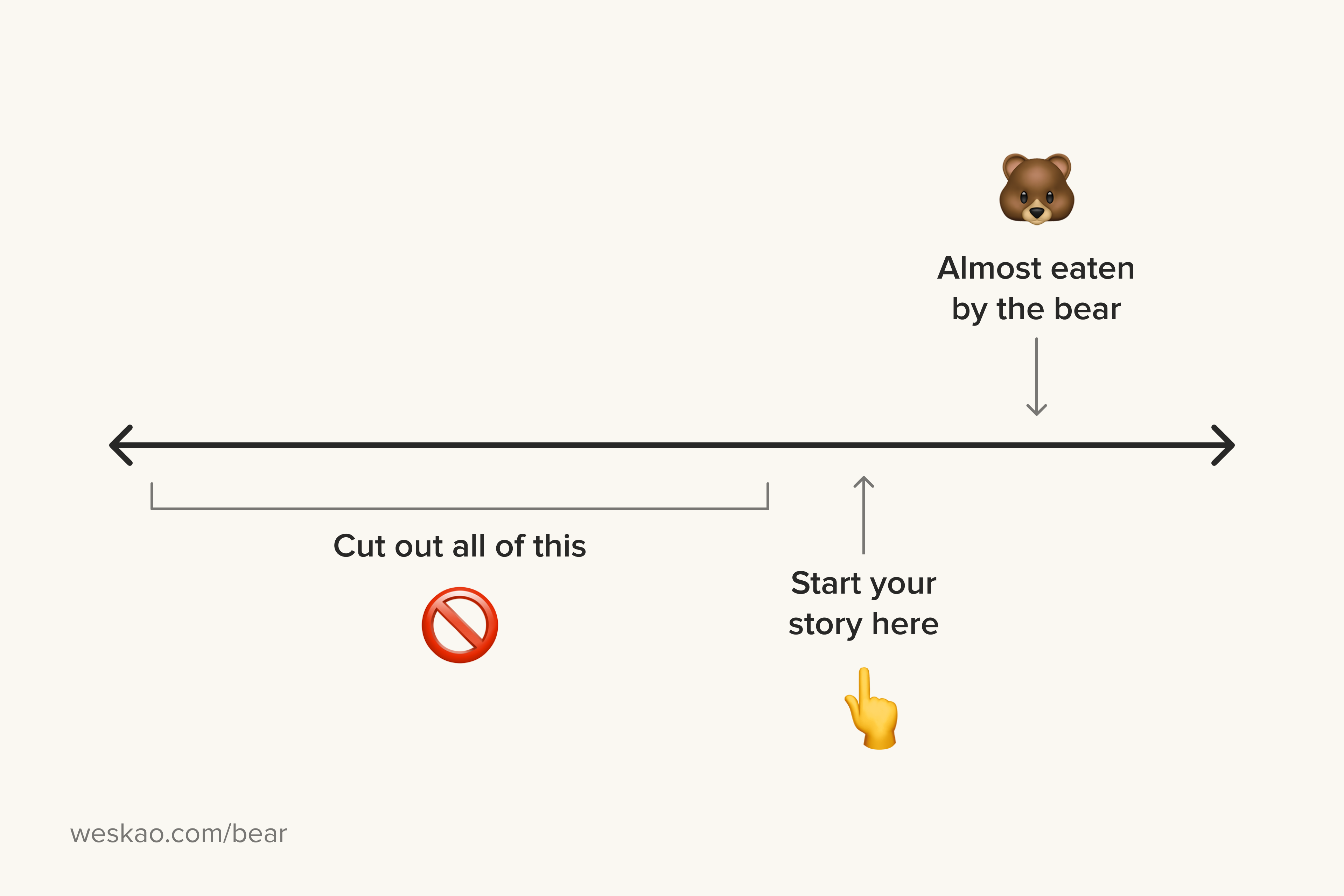
Ask yourself:
Can I cut out more of the backstory?
Does my audience really need to know this part?
What’s the bare minimum I need to set the context, so I can spend time on the juicy stuff?
4. Trying to tell a story that’s too long
Your colleagues do not have time to listen to a full hero’s journey story in a quarterly business review meeting.
Seriously, do not attempt to do a 12 step (some say 17 step!) hero’s journey type of story. Your business or project does not warrant this, and everyone will be catatonic by the time you finish.
Am I against long stories? No. Am I against boring, pointless, wtf are we talking about stories? Yes.
Long stories can be good IF you are a good storyteller. Most of us (technical or not) aren’t in this bucket. In order for storytelling to work, the story needs to hit a certain threshold of quality, and that bad is higher than people realize.
Therefore, storytelling is not as practical of a tool for most people who don’t have time to invest in getting good at it. It’s like tango. I’ve heard it takes a minimum of ten years for one to look even remotely passable doing tango. Compare that to lindy hop: it’s a forgiving dance. There are obviously professionals who are next level, but amateurs don’t look terrible and they still have fun.
Most founders and leaders should tell short stories where the narrative arc is a few minutes long at most. I might not even call them stories. I’d call this using evocative vocabulary or sharing a quick anecdote, where you use visual language to paint a picture for your audience.
This, you can easily do in as little 5-15 seconds. I did this often on Maven sales calls and internally when coaching my direct reports, and it led to the same positive outcome of telling stories but was much faster and easier to do well.
—
As usual, it’s not complicated . It’s just hard. There are hundreds of permutations and combinations of ways to tell your story, so it’s part art and part science. If it feels unnatural for you at first, it’s totally normal. Developing your muscle memory with storytelling is part of the process.
Thanks for being here, and I’ll see you in two weeks on Wednesday at 8am ET.
Wes
Connect with Wes
Is this your first time here? Subscribe (it’s free)
Follow me on LinkedIn for more insights
Learn more about 1:1 coaching to sharpen your storytelling and executive presence
✨ Improve your ability to manage up, gain buy-in, and increase your impact in a 2-day workshop. Over 1,700 students have taken the course and rated it 4.6/5 stars. → Save your spot in the May cohort
What I keep thinking about underneath your four points is the question of why this pattern is so persistent in technical leaders specifically. The over-reliance on details, the caveat before every claim, the inability to leave context out these are not communication failures. They are survival behaviours that worked in a previous context.
Most technical people were rewarded, for years, for comprehensiveness. The person who caught the edge case. The one who flagged the caveat nobody else had thought of. The one who never got caught out. That pattern was reinforced in code reviews, in architecture debates, in every room where being technically correct was the highest form of credibility.
Then they get promoted. And suddenly the room needs a different thing. Not completeness. Momentum, the skill that made them indispensable now makes them difficult to follow.
The "well, technically" impulse is not bad thinking. It is good thinking, in the wrong room. The hardest part is not learning the new skill. It is unlearning the identity that the old one built.
This maps directly to what I see in founder pitch conversations... the same instinct that makes a technical founder great at building (precision, comprehensiveness, covering edge cases) is exactly what makes them lose the room when they're pitching investors or selling to enterprise buyers.
The hardest shift isn't learning to tell a better story, it's accepting that the simplified version is more true to your audience than the comprehensive one. An investor doesn't need to understand your architecture to believe in your company. They need to understand how you see the market and why you're the one to win it. That's the better signal, right?!
Some technical founders see this challenge, understand their limitations, and appoint a CEO... look at HashiCorp! Mitchell Hashimoto and Armon Dadgar built, and still have, serious tech cred, but they hired someone else to lead the ship, Dave McJannet.