

👋 Hey, it’s Wes. Welcome to my bi-weekly newsletter on managing up, leading teams, and standing out as a high performer.
⛑️ If you’re looking for 1:1 coaching, I work with tech leaders on managing up, advocating for your ideas, and strengthening your executive presence. Clients include operators at Amazon, Meta, DoorDash, Atlassian, OpenAI, etc. Learn more about my coaching approach.
Read time: 4 minutes
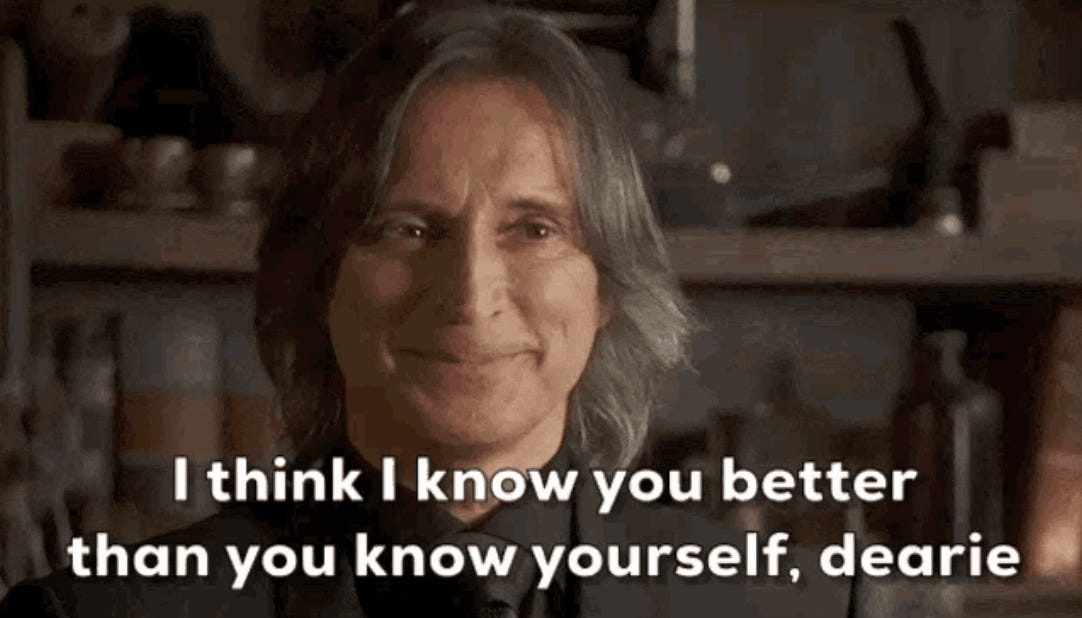
I once knew a CEO who had a habit of telling people, “I know you better than you know yourself.”
Their reaction was, “You don’t know me. GTFO.”
The thing is, the CEO often had good insights about his team. But folks were too busy feeling unfairly labeled to listen.
If you try to tell people how they are, their natural reaction will be to push back.
The solution: Avoid overly broad claims. Stick to facts of what you are able to observe. And frame your ideas as what they are: observations.
For example:
🚫 “You are X.”
✅ “You come across as X.”
✅ “You might come across as X.”
✅ “You seem X.”
This language is intentional because I don’t want to trigger people to argue with me.
It is harder to argue with me if I say, “You come across as X” vs proposing that I somehow have special insight into who you are deep down.
As a manager, I only see a slice of who you are. I don’t presume to know who you are at your core—I only know how you show up at work, and how you come across based on how you behave and what you say. So my feedback will be rooted in that.
Why you do not want to trigger people to debate you
Sometimes a debate is healthy and exactly what you’re looking for.
Other times, a debate is a distraction. You have a point, but your recipient is too hung up on some other comment you made, that they can’t focus on your main point.
I’m hyper-rational, and many of my coaching clients are tech operators who are hyper-rational too. If they sense BS, they will call you out on it. They will want to debate you. They will want to show how you are making a logical leap, and how you don’t actually have the grounds to be making such a sweeping claim.
This is not productive. I do not want to trigger someone to debate me, especially if I’m pretty sure about my point and I want them to focus on my point.
Therefore, it’s to your benefit NOT to over-reach. Don’t give your counterpart anything to get distracted by.
Speak accurately
Many problems can be avoided if you simply speak accurately. For example, see these two statements:
“X will Y.”
“X tends to Y.”
These two statements are not the same. The first implies complete certainty. The second implies that X generally does Y, but not always.
[Note: Don’t be too literal here. I’m not saying to never say “X will Y.” The context matters. If you are writing a strategy doc, you might say: “Investing in this channel will lead to more users.” The context itself implies that this is an assertion. Your reader likely knows that you can’t guarantee that this channel will lead to more users. In this case, the sentence structure is a reflection of your high conviction that this is the right path.]
Here’s an example of an overly-broad claim vs a narrower, more right-sized claim:
🚫 “You lack emotional regulation.”
^ This is a broad sweeping statement that assumes the person always lacks emotional regulation. Even if this is true, they are likely to feel threatened by this and want to prove how I’m wrong.
✅ “When you do X specific thing, you seem like you lack emotional regulation.”
^ This is a narrower claim. It’s more accurate and more objective. I point to the specific thing that leads me to believe the person could lack emotional regulation.
There is a difference in positioning, and it impacts whether your recipient hears you. It’s not only semantics.
If I say you lack emotional regulation, you might say, “Well Wes, I regulate myself plenty well in 90% of situations” and start debating me on this point.
If I say you SEEM like you lack emotional regulation, well, there’s not much you can debate there. I’m sharing how I’m interpreting your actions, and I’m clear that this is my interpretation, which might be how others see you, too. Most people are glad to hear how they might be viewed by other people. More on the importance of speaking accurately.
By phrasing your feedback more thoughtfully (which takes two seconds, as shown in the examples above), you can increase the chances your team actually listens without getting defensive.
Thanks for being here, and I’ll see you in two weeks on Wednesday at 8am ET.
Wes
PS Related reading for managers:


Connect with Wes
Is this your first time here? Subscribe (it’s free)
Follow me on LinkedIn for more insights
Learn more about 1:1 coaching to sharpen your executive presence
✨ Course: Improve your ability to sell your ideas, manage up, gain buy-in, and increase your impact in a 2-day workshop. Over 1,500 tech operators have taken this course, and every cohort so far has sold out. → Save your spot
Coaching gets harder as teams scale — especially under time pressure.
The instinct is to tell. That’s usually when coaching matters most.
Hi all, if your interested in team management tips (like this wonderful piece from Wes) and AI excellerating tools, I started a series called “I Don’t Want the Girls to Get Left Behind.” It’s my way of giving full access to the AI tools and knowledge that helped me build my company.
This space is for women, or anyone who feels like they’re struggling to keep up with the AI wave, to learn, build skills, and grow their confidence so no one gets left behind.
I figured what better way to start than learning from one of the best teachers out there, Miss Wes Kao
If you’re looking for a 101-style breakdown, send me a message. we can get started :)