

👋 Hey, it’s Wes. Welcome to my bi-weekly newsletter on managing up, leading teams, and standing out as a high performer. For more, check out my intensive course on Executive Communication & Influence for Senior ICs and Managers. NOTE: The upcoming March cohort is 90% full. If you’re interested, I’d love to see you in class.
⛑️ If you’re looking for 1:1 coaching, I work with leaders at companies like Amazon, Meta, Atlassian, DoorDash, Anthropic, etc. Learn more about my coaching approach.
Read time: 4 minutes
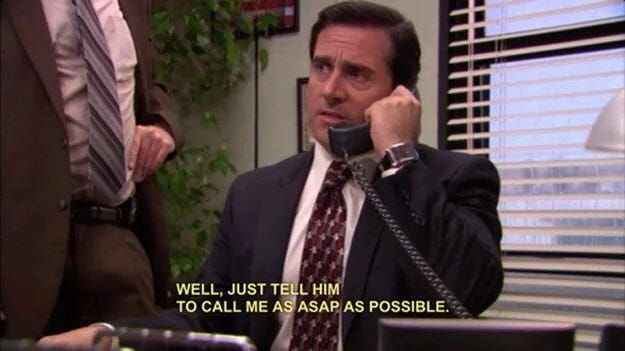
Let’s say I send you a Slack DM that says, “Hey, this is a priority.”
What do you think I mean?
You should prioritize this over all other projects for the rest of Q1.
Focus on this over other projects if you’re on the fence.
This must be done by end of week.
This must be done by end of day.
Drop everything and do this in the next hour.
Trick question, because there’s no way to know.
To be clear, I like the word “priority” and use it myself. There’s nothing inherently wrong with the word, and I am not saying you should never use it. What I am saying is:
Vague language can have a large (negative) blast radius when used haphazardly. It can create anything from avoidable anxiety to hours spent going in the wrong direction due to miscommunication. Yet, it’s surprisingly common in the workplace. Most of us have used vague language at work, and have been on the receiving end of it.
Over time, I’ve realized it’s not helpful to say “ASAP” (and similar phrases like “time-sensitive” or “priority”) without additional context.
So how do you convey time-sensitivity in a more productive way?
Move from the abstract to the concrete
Instead of talking about urgency in a vague sense, do these two things:
Talk about the sequence
Clearly define the timeline
By doing this, we move from an abstract sense of “yikes this is important and time-sensitive” to a concrete sense of what to do about it.
Here’s are scripts of what this looks like in action:
1. “Do this first. Then do this second, then this third.”
I’ve used this with more junior team members, and they’ve shared feedback that being so clear and explicit was helpful.
The benefit here is you show the stack rank of priorities. You reiterate the hierarchy of what to do, which is particularly useful if you have multiple tasks on the docket.
2. “By x date/time…”
For example:
“By tomorrow…”
“By Thursday EOD…”
I always say that “over-communicating” is usually the right amount of communication. This is especially applicable when working with new team members, junior staff, external vendors, contractors, etc.
It’s even helpful with mid-level and senior folks:
🚫 “This strategy doc is a priority so we should review it soon.”
✅ “Let’s plan to review an initial draft of your strategy doc at our 1:1 on Thursday.”
This approach is helpful when delegating too. (Here’s more on how to delegate while maintaining high standards).
3. “If you only have time to do one thing…”
“If you only have time to do one of these tasks--do this one.”
“If you were to prioritize one goal this week, make it this one.”
This helps elevate one project/task over all others. This is useful if you want to emphasize one thing and really get your point across.
4. Mention what doesn’t have to get done yet
“I’m going to leave this here for you. You don’t have to do it immediately, but can you handle it by today at 3pm?”
“I need X by EOW. Items 2, 3, 4 can wait until next month.”
There are many things that aren’t hugely urgent, but still have to get done. It’s good to be clear on what can wait. Above, I show two different styles of communicating what doesn’t have to get done right away. The first is a bit more collaborative and the latter is more concise. I’ve used both styles depending on the person and project.
For related reading, here’s more on how to be concise.
5. Default is moving forward*
“Here’s what I’m going to do if I don’t hear from you by 5pm …”
You should use this approach with judgment and finesse because it can be easy to overstep.
Use this approach for lower-risk items, like smaller/tactical decisions, tasks your manager has approved before, or ideas where you’re already generally aligned.
🚫 “Hey manager, if you don’t approve my proposal by EOW, I’m going to assume you’re on board with shutting down our current operations and launching this new business unit and having me lead it.”
✅ “Hey manager, if you don’t approve my email reply to our vendor by 5pm, I’m going to assume you’re good with it.”
You may think, “Am I at risk of being too specific? Is this being too detailed?”
Maybe.
But I think both managers and direct reports can generally benefit from being more specific.
As a direct report, you often to need to “assign” tasks to your manager as part of managing up. I loved when my direct reports were clear in sharing exactly what they needed from me, by when, and why. I could get back to them much sooner and remove myself from their critical path. I might say “I can’t do that,” but I at least knew what they needed from me without a doubt.
As a direct report, I appreciated when my managers understood that I can’t read their mind. Being more concrete allowed us to have more productive conversations and allowed me to allocate my bandwidth accordingly.
In closing: You can use words like ASAP, time-sensitive, and priority. But don’t ONLY say that and expect your recipient to read your mind. Make sure to add more context by using the scripts above.
Thanks for being here, and I’ll see you in two weeks on Wednesday at 8am ET.
Wes
Connect with Wes
Is this your first time here? Subscribe (it’s free)
Follow me on LinkedIn for more insights
Learn more about 1:1 coaching to sharpen your executive presence
✨ Improve your ability to sell your ideas, manage up, gain buy-in, and increase your impact in a 2-day workshop. Over 1,500 tech operators have taken this course, and every cohort so far has sold out. NOTE: The upcoming March cohort is 90% full. → Save your spot
Love #5. At Palantir we called this NACK, as in "Please NACK this by 5pm" and implied if you didn't get a response you were going to move forward. (This was in contrast to requesting an ACK, or affirmative thumbs up.)
Time perception is hard. I always struggle with the ASAP as well. Does it mean over what I'm doing now? I mean after it?